
Introduction
The Bombay High Court has delivered a significant judgment protecting the rights of CGHS beneficiaries, particularly retired Central Government employees and pensioners. The decision reaffirms that the Right to Life under Article 21 of the Constitution includes the right to timely and appropriate medical treatment, even when such treatment is obtained from a non-empanelled hospital under exceptional circumstances.
This judgment is likely to serve as an important precedent in future cases involving medical reimbursement under the Central Government Health Scheme (CGHS).
Background of the Case
Mr. Anirudh Prataprai Nansi, a retired Assistant Commissioner from the Central Excise and Customs Department, took voluntary retirement in 2008. As a CGHS beneficiary residing in Mumbai, he was diagnosed with cardiomyopathy, a serious heart disease requiring an urgent heart transplant.
At the relevant time, none of the CGHS-empanelled hospitals in Mumbai had the required facilities or licence to perform heart transplantation. Faced with a life-threatening situation, Mr. Nansi underwent a heart transplant at Sir H. N. Reliance Foundation Hospital, Mumbai, a non-CGHS empanelled hospital.
The surgery was successful, but the medical expenditure amounted to nearly ₹30 lakh.
CGHS Response
Mr. Nansi applied for reimbursement under the CGHS provisions applicable in special circumstances.
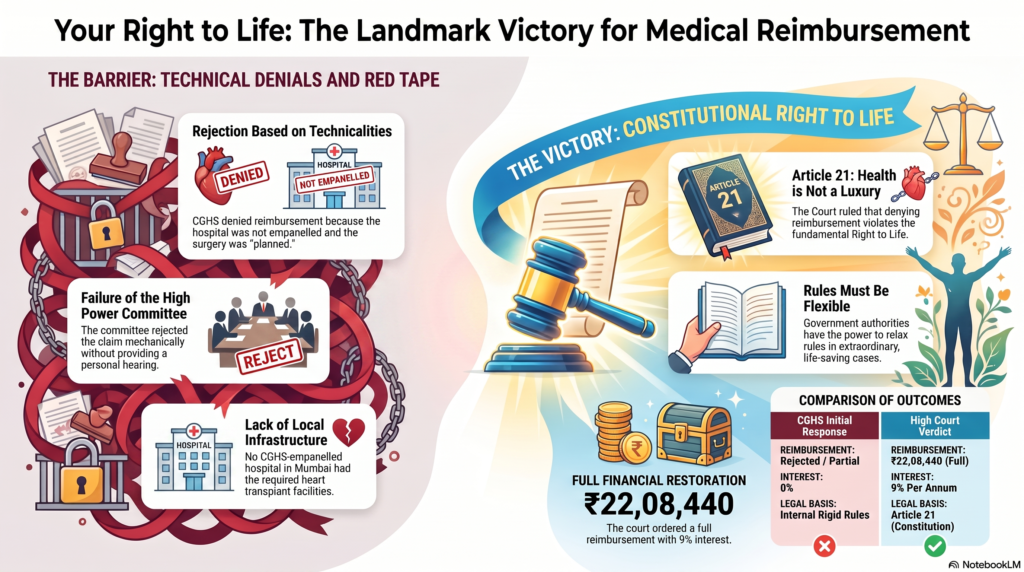
CGHS, however, reimbursed only about ₹1.6 lakh by applying the existing package rates. The authorities rejected his claim for full reimbursement on the grounds that:
- The hospital was not empanelled under CGHS.
- The surgery was considered a planned procedure rather than an emergency.
- The petitioner had accepted the applicable reimbursement conditions.
- The High Power Committee also rejected his representation without granting him a personal hearing.
The Petition Before the Bombay High Court
Aggrieved by the decision, Mr. Nansi approached the Bombay High Court seeking full reimbursement.
He contended that:
- His treatment was life-saving and medically unavoidable.
- No CGHS empanelled hospital in Mumbai could perform the required transplant.
- Waiting or travelling outside Mumbai could have endangered his life.
- The reimbursement policy was discriminatory because substantially higher package rates existed for similar procedures in other cities.
Observations of the Bombay High Court
The Court made several important observations.
1. Heart Transplant Is a Life-Saving Procedure
The Court observed that a heart transplant cannot be treated as an ordinary planned surgery. It is a highly specialised and life-saving procedure that qualifies as a special circumstance.
2. No Alternative Treatment Was Available
The Court noted that no CGHS-recognised hospital in Mumbai could perform the transplant at the relevant time. Therefore, the petitioner had no reasonable alternative.
3. Right to Life Includes Timely Medical Treatment
The Court reaffirmed that Article 21 of the Constitution protects not only life but also timely access to necessary healthcare.
It observed that denial of reimbursement in genuine life-saving situations would amount to a violation of the constitutional right to life.
4. Rules Must Be Applied with Compassion
The Court criticised the mechanical approach adopted by the High Power Committee and observed that reimbursement rules should not be applied rigidly in extraordinary medical situations.
The Government possesses sufficient authority to relax procedural requirements where justice demands.
Final Judgment
The Bombay High Court allowed the writ petition and directed:
- Full reimbursement of ₹22,08,440 to the petitioner.
- Interest at 9% per annum.
- Payment within four weeks.
- Appropriate consideration of the exceptional facts of the case.
Why This Judgment Is Important
This judgment has far-reaching implications for CGHS beneficiaries across the country.
It establishes that:
- Life-saving treatment obtained from a non-empanelled hospital may qualify for reimbursement where no suitable CGHS facility is available.
- Administrative rules cannot override the constitutional Right to Life.
- Authorities must consider humanitarian circumstances rather than adopting a purely technical approach.
Genuine medical emergencies deserve flexibility in the application of CGHS rules.
Key Takeaways
- Full reimbursement may be available for treatment at a non-empanelled hospital in exceptional life-threatening situations.
- Courts can direct relaxation of CGHS rules where strict application would cause injustice.
- Article 21 protects the right to timely and appropriate medical care.
- Pensioners should not hesitate to seek legal remedies when genuine reimbursement claims are rejected.
Conclusion
The judgment in Anirudh Prataprai Nansi vs. Union of India & Others is a landmark decision that reinforces the welfare objective of the Central Government Health Scheme.
It reminds public authorities that healthcare decisions must be guided not only by rules and procedures but also by fairness, compassion and constitutional principles. This decision will undoubtedly provide hope and guidance to thousands of CGHS beneficiaries facing similar medical challenges.
Author
Chandra Kant Bapat
If you found this article useful, please share it with other CGHS beneficiaries. Your comments and suggestions are always welcome.